
Solution

Facilities Management Software

Give facilities management teams one platform for scheduling, inventory visibility, compliance requirements, and day-of-work coordination.

Primary: facilities management software facility asset management software service management software maintenance for commercial buildings

Why teams choose Workelect

  • Reduce delays caused by stock gaps and scheduling blind spots in facilities management.
  • Help planners, warehouse teams, and field engineers work from the same live picture.
  • Keep compliance, scheduling, and inventory workflows closer to the day’s work.

Built for operations

Run facilities management software with one clearer operating view.

Workelect keeps warehouse stock, van stock, job bookings, assets, and readiness aligned so teams spend less time chasing updates.

Stay ahead of operational pressure

Coordinate jobs, engineers, stock, and site requirements for facilities management without juggling disconnected systems.

Keep inventory tied to the work

Track warehouse stock, van stock, parts, and tools against planned visits and reactive jobs.

Support compliant delivery

Keep the records, readiness checks, and service workflow needed for SLA reporting, planned maintenance records, and building compliance workflows in one operating view.

Operational needs

Facilities Management Software for real-world operations.

This section highlights the day-to-day pressure points teams need to manage across stock, compliance, and scheduling.

Industry challenges

facilities management teams often need to balance reactive callouts, site-specific requirements, labour availability, and customer expectations without losing control of the day.

Inventory issues

Parts, consumables, tools, and vehicle stock can drift out of sync with planned work when warehouse and field teams do not share one live system.

Compliance requirements

Teams need reliable records for SLA reporting, planned maintenance records, and building compliance workflows, plus evidence that jobs, checks, and follow-up actions were completed on time.

Scheduling needs

Schedulers need visibility into job bookings, stock, engineer readiness, and urgent exceptions so planned work and reactive demand can coexist.

Real use cases

Facilities Management Software in real field teams.

Examples from electricians, plumbers, and HVAC operations that need stock and job readiness to stay aligned.

Planned maintenance workflows

Coordinate recurring facilities management visits with stock and engineer readiness checks before dispatch.

Outcome: Higher schedule reliability across planned work.

Reactive callouts

Prioritise urgent jobs with visibility into nearest available engineers, parts, and route constraints.

Outcome: Faster response with fewer avoidable revisits.

Compliance-led delivery

Capture records and evidence aligned to SLA reporting, planned maintenance records, and building compliance workflows without breaking day-to-day flow.

Outcome: Stronger audit readiness and clearer service accountability.

Deep dive

Facilities Management Software guide for operations teams.

Detailed guidance for teams evaluating process improvements before software rollout.

Why facilities management software gets harder as teams scale

Growth increases job volume, field movement, and operational dependencies. Without integrated visibility, planners and engineers spend more time resolving uncertainty than delivering planned work.

Coordinate jobs, engineers, stock, and site requirements for facilities management without juggling disconnected systems. This is where structured workflows outperform spreadsheet-led coordination, especially when multiple teams share stock and scheduling responsibility.
Operational gaps to close first

The highest-impact improvements are usually simple: clearer stock ownership, earlier readiness checks, and stronger handoffs between planning and field teams.

Track warehouse stock, van stock, parts, and tools against planned visits and reactive jobs. When these controls are standardised, delivery quality improves and avoidable friction drops across the whole operation.

How teams measure progress with facilities management software

Track repeat visits, stock-driven delays, emergency purchasing, and planner rework. These measures expose execution quality far better than high-level output totals alone.

As process stability improves, teams usually see predictable gains: reduce delays caused by stock gaps and scheduling blind spots in facilities management. and help planners, warehouse teams, and field engineers work from the same live picture.. Those outcomes are what make software investment commercially meaningful.

Operating profile

Where facilities management software has the biggest impact.

A practical profile of team shape, delivery pressure, and the buying trigger behind this workflow.

Best-fit team

Industry service teams balancing compliance, scheduling, and facilities management software execution.

Daily job mix

Industry work with recurring planning, exception handling, and execution updates tied to facilities management software.

Most common bottleneck

Operational handoffs rely on memory instead of a shared workflow for facilities management software.

Buying trigger

Service performance is unstable because readiness signals for facilities management software arrive too late.

Workflow sequence

How teams run facilities management software day to day.

A concrete execution sequence from planning through close-out.

1. Prioritise service demand

Rank work by risk, SLA impact, and compliance pressure linked to facilities management software.

2. Prepare resources

Confirm labour, stock, and site constraints before dispatch commitments.

3. Execute with evidence

Capture service outcomes and exceptions in-flight for traceable accountability.

4. Audit operating health

Review failures and trend patterns to refine service standards each month.

Operational KPIs

What to measure in the first 90 days.

Use these metrics to confirm whether process changes are improving delivery quality.

Dispatch exception rate

Target: Reduce by 25%

Fewer exceptions indicate stronger pre-dispatch planning.

SLA compliance

Target: Improve by 15%

Measures whether planning and execution are aligned to customer commitments.

Compliance evidence completion

Target: 95%+

Protects audit readiness across service delivery.

Execution signals

What good implementation looks like.

Indicators teams use to validate that the new workflow is genuinely embedded.

  • Service delivery evidence is captured consistently alongside facility asset management software and compliance actions.
  • Planned and reactive work are managed in one operating rhythm.
  • Exceptions are traceable from root cause to corrective action.
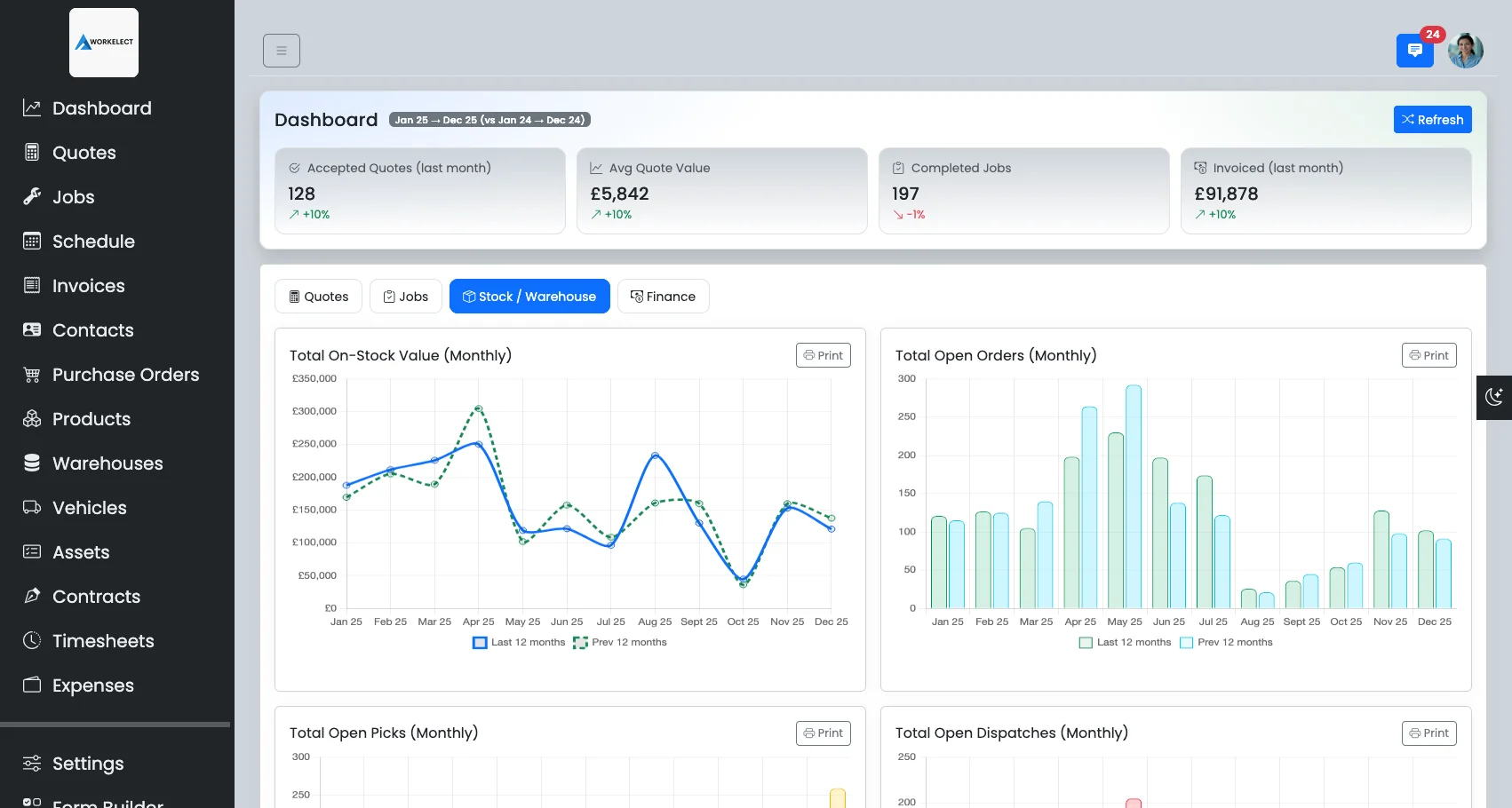
Facilities Management Software dashboard preview

What this covers

Facilities Management Software

Workelect helps teams connect stock visibility, booking control, and day-of-work readiness in one operational view.

  • facility asset management software
  • service management software
  • maintenance for commercial buildings
  • property maintenance software

FAQ

Facilities Management Software questions

Short answers to common questions around this workflow.

It is suited to facilities management teams that need to coordinate service work, inventory, compliance, and scheduling from one platform.

Yes. Workelect connects warehouse stock, van stock, replenishment, and job demand in one workflow.

Yes. The platform is designed to support recurring work, reactive jobs, and the records teams need to stay audit-ready.

See Workelect in action

Bring stock, job bookings, assets, and field readiness into one platform.

Start a 14 day trial or contact us to talk through your workflow.